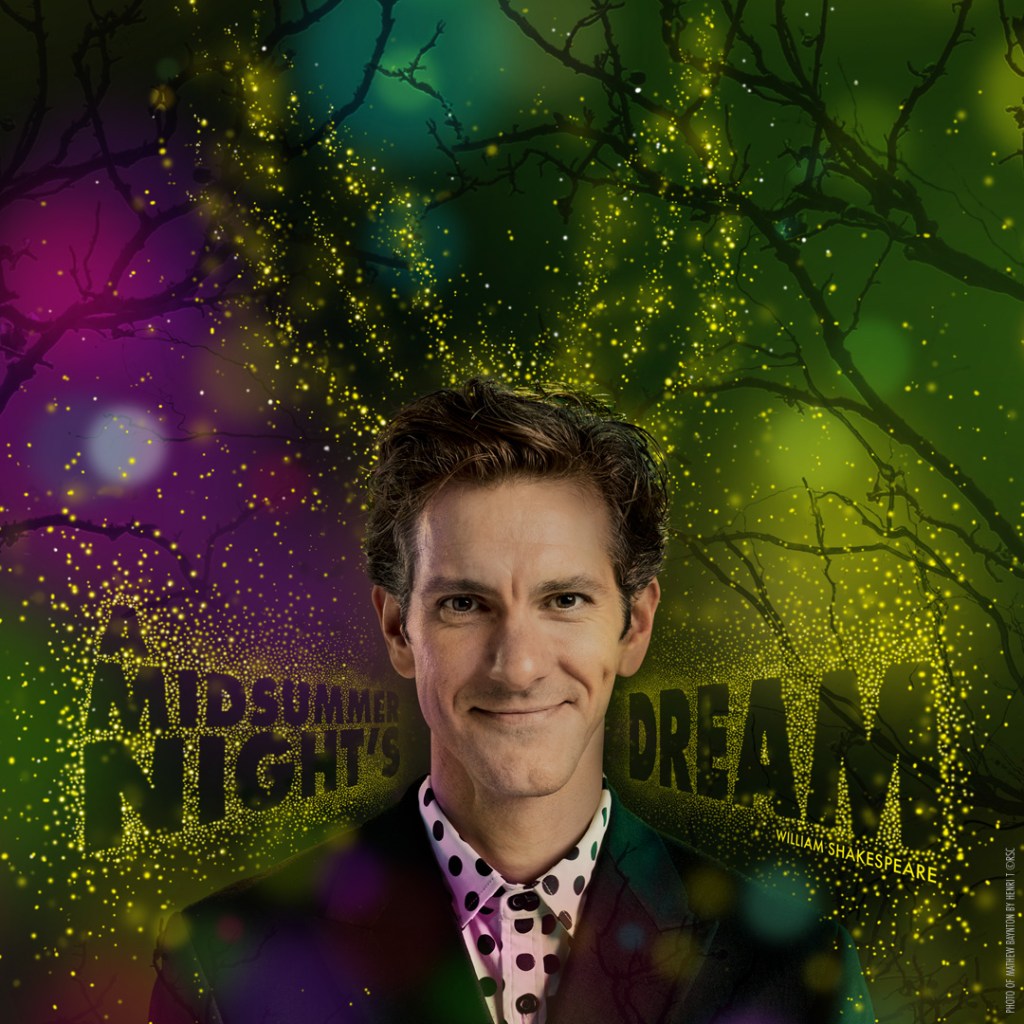
One of Shakespeare’s most beloved and famous comedies has been brought to life by the Royal Shakespeare Company in Stratford-Upon-Avon. Is it worth watching?
A Midsummer Night’s Dream is the first play of 2024 for the Royal Shakespeare Company (RSC). Directed by Eleanor Rhode, who has previously directed King John at the RSC in 2019. The play itself is multifaceted, taking in through each twist and turn various story lines and plot points that weave together for a conclusion which will have you believing you were in a dream.
We initially follow Hermia (portrayed by Dawn Sievwright) as she is faced with the problem that she loves Lysander (portrayed by Ryan Hutton), but her father is insistent that she marry Demetrius (portrayed by Nicholas Armfield). Hermia is given the choice to marry, as her father wishes, or else face a punishment, which could be death or life as a nun – never to marry or love again. She is to make her decision by the next day. Lysander comes to her aid with a plan. They will meet in the woods at night and then set off away from their home where he will marry her and they will live happily ever after. However, Hermia’s friend Helena (portrayed by Boadicea Ricketts) is in love with Demetrius, who spurns her attention. Having been told of their plan by Hermia herself, Helena plots to have Demetrius find Hermia and Lysander in the woods, believing that he will realise that Hermia is never going to marry him and instead fall for Helena.
That is where we leave this initial cast as we are introduced to the second tale that is taking place. The mischievous spirit Puck (portrayed by Rosie Sheehy) is commanded by her master Oberon to fetch a flower that acts like Cupid’s arrows. The pollen is to be smeared on the eyes of Titania (portrayed by Sirine Saba) the Fairy Queen and love of Oberon. Under the flower’s spell she will fall in love with the first creature she sees. Oberon plans for it to be some kind of beast. He will then use a cure which he has, believing that Titania will be embarrassed and bend to Oberon’s wishes.
Whilst waiting for Puck to return, he witnesses an exchange between Helena and Demetrius. Feeling for poor Helena, he instructs Puck, upon her return to use some of the flower’s magic on the couple. His instructions are not specific enough and Puck causes Lysander instead to fall madly in love with Helena.
The third and final group who are interwoven in this tale is a troupe of actors who are preparing a play to be performed at the Duke’s wedding. They are practicing in the woods when Puck comes across them. Fascinated by the group, she causes a little mischief and chaos. In the midst of it she turns one of the actors, Bottom (portrayed by Mathew Baynton) into a donkey. Puck arranges for the donkey to be the first creature that Titania see’s when she wakes after having been enchanted with the love flower.
What follows is drama and hilarity as the human couples awaken to discover new passions for each other, as well as confusion and anger from spurned loves. Titania and the donkey are very happy together. Oberon however is less happy, he watches the mortals and the way they act. Puck revels in the chaos but Oberon insists they set things right. He sets Puck the task of restoring Lysander’s love for Hermia, but decides to leave Demetrius in love with Helena. The couples fall asleep and Oberon informs us that the events of the night will seem as though a dream.
Oberon cures Titania of her love for the donkey and the two agree to be together in happiness. Puck returns Bottom to his human form who rushes off having had the most wonderful dream to regain his acting troupe.
The next morning, having found and pardoned the two couples, the Duke invites them to be married alongside him at his wedding. A happy ending for all. There is only one more part of the play left. The acting troupe are to perform at the wedding and we get to watch.
I will not detail it here, but it is well performed and had the audience laughing out loud and clapping along. A definite highlight of the whole performance.
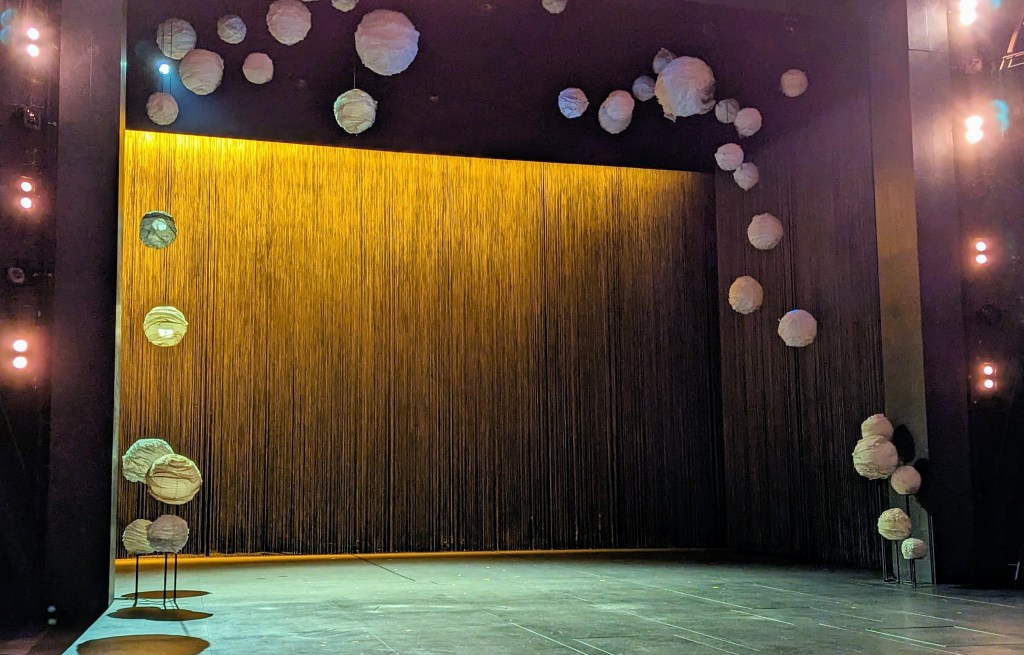
The staging for A Midsummer Night’s Dream was simple but effective. There is extensive use of projectors to create scenes and atmosphere. This seems to be becoming more common. It has many advantages, it enables a scene to change quickly whilst also adding movement and depth. It is also cost effective as less scenery needs to be custom made for each play. Overall, the set design draws you in and fills your imagination.
I would like to draw attention to the amazing sound design for this play. I do mean amazing. I would go as far as to say it is the best sound design of any play I have seen at the RSC so far. The band plays some very enjoyable tunes whilst the audience is entering and sitting down. A first to my recollection. It helped make the whole experience more enjoyable and also allowed a build up to the start of the play. Within the play there are several instances of magical beings speaking, their voices seem to dart around the theatre making you feel as if they are all around you. The sound effects mixed with some light tricks make the magic seem more real. All adding to the sense of immersion. Finally there are a few musical numbers with singing performed by Rosie Sheehy. With the play not being a musical, there is always a risk that singing may break the mood or emersion. Luckily these songs are tastefully done and are very thematic. The songs bring you further into the story and the experience.
The actors, who are a mix of experienced RSC performers and those making their debut at the RSC each perform their roles perfectly. It is difficult to pick a standout character. There was a risk that by having a mainstream known name in the play in the form of Mathew Baynton, that the play may have pandered to making him the focus. I am pleased to say that although his performance was amazing, in no way was any extra attention drawn to him. In fact, when the cast came out to bow and take their applause from the audience, he remained at the back of the pack.

There were some stand out performances for me. Dawn Sievewright’s performance of Hermia as a debut was impactful. She convinced me she was a woman in love who was strong-willed enough to go after what she wants whilst also having a soft side. Rosie Sheehy, who has impressed me in the past, once again delivered an outstanding performance. In many ways I felt as if the role of the mischievous Puck was made for her and she delighted in being at the centre of the chaos. Ryan Hutton who also is enjoying his debut is one to watch. He delivered his lines with strength but also on many occasions matched Mathew Baynton for delivering comedy and making the audience laugh.
And what of Mathew Baynton? Known for his skills in the world of comedy the role of Bottom was a natural choice. He performed with all the grace and skill you would expect from a professional actor He never overstepped his role. I foresee that if he chooses to spend more of his career on stage, he will have a glittering career. I hope he has enjoyed the experience and will return for future plays.
Overall, it may be obvious from this review so far, I enjoyed the play. 2024 is off to a great start for the RSC. A Midsummer Night’s Dream is an astonishing, mesmerising play which will have you wondering if you have just had the best dream of your life. Every aspect of the play is perfection. The casting, direction, sound design and performance are all at a level above what you would expect. The bar has been raised, and I look forward to what the rest of the 2024 season brings.
If you can, I highly recommend seeing a Midsummer Night’s Dream. It is on at the Royal Shakespeare Theatre in Stratford-Upon-Avon until 30th March 2024.
Find out more about the Royal Shakespeare Company: https://www.rsc.org.uk
Find out more or book A Midsummer Night’s Dream: https://www.rsc.org.uk/a-midsummer-nights-dream/





 Christopher Murray
Leave a comment